|
Despite cynical reports to the
contrary, Perry Como was no square. Given, as one writer put it, his
"ultra-mellow" approach to a song, Como should already have been
elevated to icon status by youthful slackers everywhere. During an
extraordinarily long and fruitful career, he was craftily turning casual into
cool. For example, when asked how he maintained his clean-cut good looks, he
replied, "laziness, Italian cooking, and lying about on a sofa as much as
possible."
This was an artist who told
a reporter that the best way he'd found to learn a new tune was to go out on
his rowboat and listen to a tape of the song
—
and, of course, to catch a few fish while he was at it. As his friend, the
jazz writer Benny Green, wrote in London's The Guardian: "A thoroughly
decent, amiable, relaxed character with a sublimely beautiful voice, he was
a persuasively argument for the theory that it is possible for a man to
become a world celebrity without mislaying his composure."
Pierino Ronald Como was one of
13 children, born in 1912 to an Italian immigrant couple and raised in
Canonsburg, Pennsylvania. When he was 11, Como started doing chores at a local
barber shop; by the time he was 14, he was running the place. Como liked to sing
while he worked, and, as a young adult, he performed at local functions, from
weddings to events sponsored by the Sons of Italy. Although he could also play
the organ and read music, performing was an avocation. Haircutting was his
career. But he did decide one day to audition as a vocalist for the
Cleveland-area bandleader named Freddie Carlone
—
and promptly got the job. After gigging for a few years around Pennsylvania and
Ohio, he was spotted by nationally known orchestra leader Ted Weems at a Warren,
Ohio casino. Weems offered to double Como's salary ( to about $50 a week ) and
Como's young wife, Roselle —
his childhood sweetheart and lifelong companion
—
urged him to take the job. Even so, Como held onto his membership in the
Hairdressers Union until well after his career took off.
Though Como artfully employed
his baritone on dramatic romantic balladry like the 1946 hit "Prisoner
of Love," he would shed that formally for an unbuttoned -collar
approach that turned him into a major recording, radio, and television star
in the '50s and '60s. As evidenced here, his repertoire alternated between
light-hearted novelty tunes and straight-up love songs. The more kitschy
material definitely has some Space Age Bachelor Pad appeal for today's
swingers; director Steven Soderbergh used "Papa Loves Mambo" for
his sleek remake of the Rat Pack vehicle, Oceans Eleven. Back then,
Como just wanted to keep his audience interested. As he once explained,
"They get tired of hearing 'Melancholy Baby' and those mushy things.
But those are songs that, as a singer, you love to sing." His gentle
rendition of "Catch a Falling Star," a No. 1 hit and Grammy Award
winner that became a signature song for him, represents the best of both
worlds.
Bing Crosby described him as
"the man who invented casual." Como defined both the sound and the
attitude of "easy listening." He often explained that his calm
demeanor on camera was a reaction to the chaos of putting on a live TV show back
in the earliest days of the medium. Viewers couldn't tell, but he was simply
acting as the calm center of a production storm. "They were always telling
me to use my hands more," Como once said. "But that was never me. I
just breathe."
Though he seemed like the
very antithesis of rock and roll —
in fact, maybe because he was —
Como continued to have hits long after Elvis and the Beatles stormed the
charts. Even in the 70s, he had success with "It's Impossible," a
florid remake of a Spanish-language tune, and Don McLean's "And I Love
You So" ( produced by RCA stalwart Chet Atkins ).
Compared to today's one-hit
wonders, Como's staying power in the music biz was staggering. He was laid-back
in temperament, but his work ethic was fierce. His deal with RCA lasted 50
years, from the 40s to the 90s, and it's been estimated that he's sold 100
million records. But success never went to his head, or at least to his
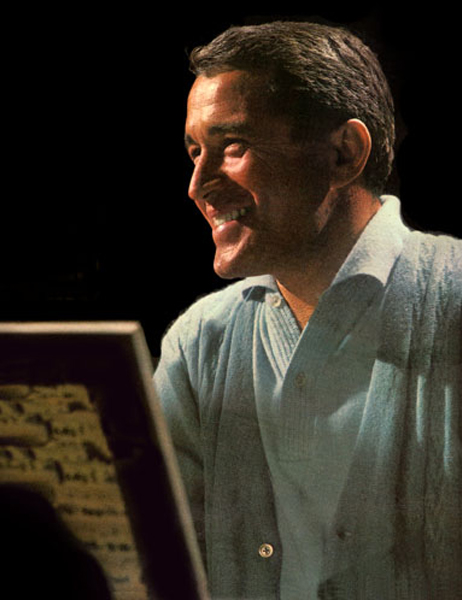
wardrobe. During years of weekly television appearances, he generally chose to
appear, as one British writer put it, "impeccably be-sweatered." He
really dug those cardigans.
Cardigans are comfortable,
comforting, and, let's face it, kind of cool. Just like Perry Como, the
subtlest swinger around.
Michael Hill
Compilation produced by: Rob Santos
& Gretchen Brennison
Mastered by Emily Lazar at The Lodge, NY
Assisted by Sarah Register
Liner Notes: by Michael Hill
Project Managers: John Hudson &
Jeremy Holiday
Art Direction and Design: Mathieu Bitton
www.CandyTangerine.com
Photos courtesy of: BMG Archives
BMG HERITAGE RELEASE 2003
CD BMG 82876 51293-2
Low Line
Compact Disc
|