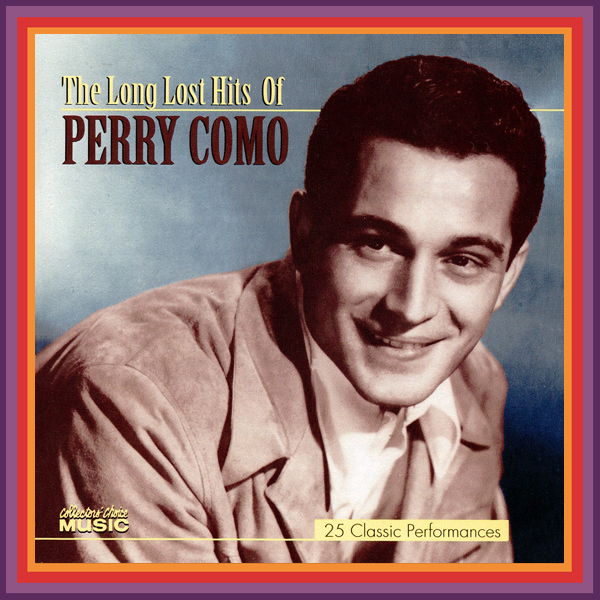
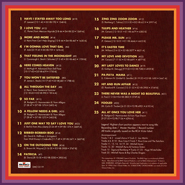
Compilation Liner Notes ~ The statistic books tell us that Perry Como has scored 150 hits. That's more post-War hits than anyone but Elvis. More than the Beatles, and more than Crosby and Sinatra combined. Yet most of us would be hard-pressed to name more than twenty or thirty of them. We certainly remember the smashes from the Fifties when Perry had his top-rated television show, but many of his earlier hits have dropped out of circulation. Rarely if ever reissued, they are almost the secret history of Perry Como. "The young man CBS is grooming to restore the sigh and swoon after Sinatra retires his jitterbug-proof barricades in Jersey, stands as straight as a sapling, and he hath not the lean and hungry look that Sinatra fans now find so endearing. His name is Perry Como. He is darkly handsome, pleasantly wholesome, and mercifully unaffected. When he sings he seems to be suffering no pain at all." That's how Perry was introduced by the New York World Telegram in June 1943. He already had line-ups around the corner at the Copacabana, and, as of the 17th of that far-off June, he had an RCA contract in his pocket. The pieces were falling into place after a decade of near obscurity. Perry had been a vocalist with Ted Weems, but, sick of the endless travel, he'd decided to return home to Pennsylvania when Weems disbanded in December 1942. Only the intervention of his agent, Tommy Rockwell, persuaded him to go solo. A spot on CBS radio was followed by a stint at the Paramount. Very quickly, Perry Como was a name on everyone's lips. The only problem was that a Musicians Union strike had been in effect since June 1942, and despite entreaties from President Roosevelt, it endured. RCA was the last company to sign with the union in November 1944. By then, Perry had six hits, all recorded with just choral support. "Have I Stayed Away Too Long" has become a country standard ( Bobby Bare, Waylon Jennings, and others have cut it ), but it makes more sense as a wartime selection. Our other a cappella track is Cole Porter's "I Love You." Apparently, Porter told Mike Todd that he felt none of the songs he had written for Mexican Hayride would be a hit. Todd asked him, "What's the most cliché'd title in the world?" Porter replied, "I Love You." Todd then bet Porter that he could write a hit song with that title. Perry's version wasn't as popular as Bing Crosby's, but Crosby had the advantage of recording with a band as his label had settled with the union. Shows and movie scores provided Perry with many of his hits in the Forties when pop music was song-driven and the same song would be recorded by many artists. "So Far" and "A Fellow Needs a Girl" were the two fines songs from Rodgers and Hammerstein's Allegro. Sinatra and Perry chased each other up the charts with both, but the show's short run curtailed the songs' shelf-lives. "Just One Way to Say I Love You" was one of two popular songs ("Let's Take an Old-Fashioned Walk" was the other) from one of Irving Berlin's less successful shows, Miss Liberty (sandwiched between Call Me Madam and Annie Get Your Gun). Perry and Jo Stafford took the song to the charts. "Bibbidi-Bobbidi-Boo," on the other hand, was a very successful song from a very successful movie, Cinderella. Perry's version was one of four that charted, and it became another of the daffy songs he performed with such aplomb throughout his career. Of all the movie and show tunes here, the only one Perry introduced was "Here Comes Heaven," a song from his movie Doll Face. Perry's movie career is something of a sore spot with him, though. "Oh, please, please," he says when the subject comes up. "I get sick to my stomach when I see them." He asked to be released from his contract to concentrate on television. He alone of his contemporaries sensed the new medium's potential. After 1950, Perry drew far fewer songs from shows and relied more heavily on RCA to locate songs. Sometimes, as on the unjustly neglected "On the Outgoing Tide" or Meredith Willson's non-show tune "It's Easter Time," the results were exquisite. He took two songs, the poignant "Tulips and Heather" and "My Love and Devotion," from British composer Milton Carson; in England, Doris Day had a hit with the latter. Meanwhile, Perry was finding that brisk tempo numbers like "Pa-Paya Mama," which nodded toward the then-current mambo craze, and "Zing Zing, Zoom Zoom" went over better on television. The latter, incidentally, featured an orchestra conducted by the composer, Sigmund Romberg, and might very well have been the last song the great Hungarian-born composer wrote. In 1953, Perry celebrated ten years with RCA. He had sold 35 million records, and RCA showed its appreciation by opening a pressing plant in his home town. Two years later, Perry was still RCA's biggest star, although the label was about to sign a little-known country singer named Elvis Presley. We stop on the cusp of the rock 'n' roll era. "Fooled" by Mann Curtis (who later set English words to "Let It Be") and Doris Tauber ("Them There Eyes") was the distinctly non-rock 'n' roll flip-side to Perry's rock hit "Tina Marie." Curtis and Tauber set it to a theme by Franz Lehar. We close with one last show tune, Rodgers and Hammerstein's "All At Once You Love Her" from Pipe Dream, an adaptation of Steinbeck's Sweet Thursday. In these unjustifiably overlooked recordings we hear Perry Como's quiet authority and aching precision at any tempo and in any mood. Every song, whether somber, romantic, or plain silly, receives its due. He is the consummate singer, always in exquisite taste. Finding these twenty-five lost hits after all this time is like coming into an unexpected legacy. Colin Escott1998 BMG SPECIAL PRODUCTS MONAURAL DMC12119 SOURCED FROM ORIGINAL RCA RELEASE MASTERS Distributed by Collectors' Choice Music P.O. Box 838 900 North Rohlwing Road Itasca, Illinois 60143-1122 USA Telephone: ( 630 ) 775-3300 Facsimile: ( 630 ) 775-3340
|