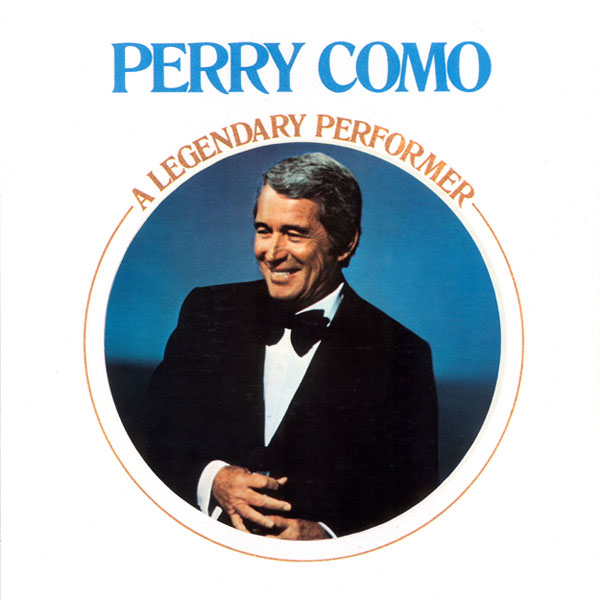
 ALBUM NOTES Perry Como a legendary performer? Sure — that’s how just about everybody feels about him — everybody except maybe just one person. That’s Perry himself, simply because he refuses to take himself that seriously. Oh sure, he’s serious about his music, otherwise why would he always sing so well and in such good taste, coming to all sessions, whether they be recordings, concerts, radio or TV shows always so well-prepared, always knowing what he wants to do and then going straight ahead, with a minimum of fuss and bother, and doing it. Temperament? Egocentricity? Delusions of grandeur? Forget them all. They’re not part of Perry — and never were. Two things about his head: (1) He knows exactly where he’s at, and (2) It hasn’t grown one-eighth of a hat-size since the day he arrived in New York back in the early ‘40s, fresh out of the Ted Weems band.
Perry had that sort of "someone," a very important agent named Tom Rockwell, who a decade earlier had helped another young singer named Bing Crosby move away from Paul Whiteman’s band and into the solo arena. Como, now living the relaxed life in Florida that befits his low-key personality ("Down here, I don’t see anybody but an occasional fish," he recently quipped.), recalls Rockwell with fondness. "He was more than an agent. He was a friend who cared about music and people. The first time he asked me to come to New York I said "no" because I thought he was just going to put me with another band, and I’d had enough of those one-nighters. But then when I told Tommy what I really wanted to do — to go out on my own — he got busy and got me a late-afternoon sustaining radio show of my own on CBS." Rockwell, head of the then-famous Rockwell-O’Keefe agency that later became General Artists Corporation, wielded enough clout to secure other important engagements for his new client: theaters, including the all-important New York Paramount; clubs, including New York’s prestigious Copacabana, and, most importantly of all, a recording contract with RCA Victor Records. There was one big drawback, though: The musicians union had called a strike against the recording companies, so that on his first dates Perry had none of the sort of instrumental musical backing he had grown used to. Instead, he was given merely voices (The records were described as "Voca-dance," that emoted occasional "ooh-wahs" in the background. But they must have made some sort of favourable impression on the emerging star because whenever possible thereafter — on his radio and TV series as well as on records — Como used singers, along with musicians, of course, to whom he has related especially well. As a matter of fact, New York’s top studio musicians, with whom he worked for years, have always welcomed calls to work with Perry, primarily because he treats them with the respect that both he and they feel they deserve. What’s more, he has often come up with a few subtle and not-so-subtle moves that led to a few extra bucks in their paychecks. "The guys at RCA never knew it," Como confessed recently, "but I usually managed to do something that would take us into overtime, so the musicians would get something extra — you know, things like stopping to eat a sandwich . . . or blowing my nose a lot . . . or doing a few extra takes . . . or even going to the bathroom." Perry’s rapport with musicians extends back to some of his happiest days — to his first important band-singing job with the Freddy Carlone outfit that often played in the Cleveland area. There the young singer came in contact with Russ Columbo, one of the most romantic sounding singers of the early ‘30s. "We used to work at the New China Restaurant, and right near us, at the Lotus Gardens, Russ was leading his own band. We became very good friends."
Como’s career with Carlone, which began in 1933, the same year he married Roselle Belline, still his wife almost half a century later, ended three years later when Ted Weems, an important bandleader, heard him. Luck played an important part, Perry points out. "We were working at a gambling casino and Ted came in and played the ‘double oh’ in roulette, and it won. He was feeling pretty good by then, so he offered me the job." Weems, a gentle person, helped Perry develop the simple, direct approach that has remained one of his distinctive charms. Like many immature singers, Perry tended to over-sing. "I told him," Weems recalled several years ago, "that he had been endowed with a fine voice and there was no need to embellish it with vocal tricks. I suggested that he just open up and sing the words from the heart." Decades later, while discussing the selections that make up this very album, Perry echoed his former maestro’s advice. Commenting on It’s Impossible, the 1970 recording that became his biggest hit in more than a decade, he pointed to "the simplicity of it. I’d learned to stop showing off and creating a bag of nothing. It’s important to let people understand exactly what you are doing." The message of It’s Impossible comes through soft and clear. "The funny thing is that when I first heard the tune I wasn’t really choked up about it, but the late Ernie Altschuler, who headed up the RCA pop division at that time, insisted I record it. Then it began to grow on me, and so the next week I went back into the studio and did just one more take to the orchestra track. And you know, to this day I’m not sure which one of my takes they released!"
Speaking of sessions in Nashville, Perry remarked, "I’ve learned to love recording down there. That Nashville scene is a book in itself. You go into the studio and there are four guys who can play your song in any key you want. I’ve done tracks there with just a rhythm section — all the rest, the strings and everybody, were added later. And there’s such a good feeling going on there. Everybody works together so easily that it gets so relaxed that sometimes nobody even knows who’s going to give the down beat. Whoever’s ready just starts out."
Como lavishes similar praises on Ray Charles, whose singers appear with Mitchell Ayres and the orchestra on This Is All I Ask. Ray has served with Perry for over two decades, assembling some of the country’s finest back-up singers not only for his recordings, but also for his radio and TV series. "At this stage of my career," Como recently proclaimed, "I’d really be lost without Ray and Nick. They know exactly what I think, and they can anticipate all my needs. And they’re both such fine men to work with and to have as friends."
For years, Como and Ayres had a mock ethnic battle going on about string players. "On all those New York recording dates, he would use only Jewish fiddle players. I used to come in and plead with him, ‘Mitch, give me just one Italian fiddle player, won’t you?’ It turned out to be a running gag. Then, finally we go to Italy to record and, sure enough, I win — there’s a whole room full of Italian fiddle players!" Souvenir d’Italie was recorded in Rome, where, because of a lower recording scale, lush sides are less costly. "Instead of the usual 16 strings, we must gave had about 116!" estimates Perry. "But about half of them were somebody’s cousin, and about half of those didn’t play. They just held their instruments and made believe. But it was a gorgeous sound alright!" Records naturally have played an important part in Como’s career. But so have radio and television, where his relaxed charm and, on TV, his inherent good looks attracted listeners and viewers. Following his 1943 sustaining series on CBS, he became the star of the "Chesterfield Supper Club," a five-times-a-week, fifteen-minute program on which for a time he shared equal billing with Jo Stafford. By 1950, the show had shifted to television where it lasted for five more years. Then came a 25-million-dollar contract to star on the Kraft Music Hall, a top-rated, one-hour show that lasted until 1963. In addition to many great guests, it featured the Ray Charles Singers and the Mitchell Ayres Orchestra and Perry’s lovely theme, Dream Along with Me (I’m On My Way to a Star), which, as Perry notes, "very few people ever heard all the way through." It’s here, though, complete with the same orchestra and singers with who Perry performed it in abbreviated form for so many years. One of these days, Perry would like to record Dream Along with Me again, perhaps dressing it up with a more modern arrangement, just the way he recently did with his first million-seller, Temptation, a tune he’d always wanted to do "ever since I saw Bing Crosby sing it in a picture called ‘Going Hollywood.’ Fifi D’Orsay was in that film, and I’ll always remember Bing singing the song at a bar, playing the part of a half-stoned singer." This new version, arranged by Nick Perito, uses many of the musical innovations of the ‘70s, including electronics. "So many of today’s sounds are so wild and wonderful," Como recently exclaimed. "I’d like to re-record more of my early favorites and give them today’s flavor." One of Perry’s all-time favorites is aptly titled My Favorite Things, one of many show tunes that he liked to feature on his TV series when he saluted America’s outstanding composers. "That was the part of my career that I really enjoyed," he recently recalled, "when we were planning those shows. We’d have guys like Dick Rodgers and Oscar Hammerstein (composers of My Favorite Things) and Irving Berlin — we had a different composer every week — come up to the office to help us plan their shows. We’d sit back and talk. It was really a big thrill for me. I can remember Dick Rodgers sitting down at the piano and playing and sometimes even singing some of his songs for us." Perry reviewed a different collection of songs when he planned his recording sessions in Rome. From the hundreds of Italian folk songs, he and his staff selected "not only what we felt were the best, but also those that were most recognizable." Of these, Anema e core, which, according to Perry, translates into Heart and Soul, certainly rates high on the All-Time Italian Hit Parade. Equally well-recognized and rating high on the Hit Parade of another country, Brazil, is the relaxed, free-flowing Carnival, the them from the movie, "Black Orpheus." To Perry, as well as to the many jazz musicians who have performed the number, this is simply "one beautiful tune." Most Latin music impresses him as basically happy music. "I remember those few dumb movies I made with Carmen Miranda. Even then, the music was happy-sounding and free."
And finally there’s Sunrise, Sunset, for Perry, "such a beautiful song," from the Broadway musical "Fiddler on the Roof." Molly Goldberg was the one who inspired me to sing this. She used to appear on our TV show, and she was such a warm, wonderful person. I remember she even used to call me ‘Perrila,’ which is an affectionate translation, I guess, of my name." Affection is something so many people have felt for Perry Como for so many, many years — not only the performers and producers and all the others who have worked with him throughout his career, but even more so those who have been closest to him in a very personal way: his attractive wife, Roselle, to whom he has been married since 1933, and his two sons and a daughter who have presented him with the grandchildren on whom he, in turn, can pour out his own affection. A good man, a warm man, a decent man is Perry Como in the eyes and ears of all who have known and heard him. And as a performer he has, despite any disavowals, surely qualified for the role of a legendary performer. But as a human being — well, he’s still so very much a part of all of us that who could ever want to put him way up there on some pedestal. He’s much, much too much down-to-earth for that! — George T. Simon Author of The Big Bands Published by Macmillan Publishing Company And The Big Bands Songbook Published by Thomas Y. Crowell Company 
|
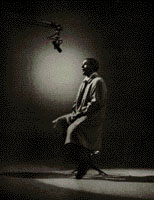 It was 35 years ago when he
decided to make that move — the same sort of move
that Frank Sinatra had just made away from Tommy
Dorsey’s band — to start a new career as a
single. Other future stars were to do the same thing: Jo
Stafford, also out of Tommy’s band, Doris Day out of
Les Brown’s, Dick Haymes out of Harry James’
and Peggy Lee out of Benny Goodman’s. It took guts
and a certain amount of self-confidence to break out of
those incubators, and if you had someone important behind
you, who really believed in you, then such a move became
just that much easier.
It was 35 years ago when he
decided to make that move — the same sort of move
that Frank Sinatra had just made away from Tommy
Dorsey’s band — to start a new career as a
single. Other future stars were to do the same thing: Jo
Stafford, also out of Tommy’s band, Doris Day out of
Les Brown’s, Dick Haymes out of Harry James’
and Peggy Lee out of Benny Goodman’s. It took guts
and a certain amount of self-confidence to break out of
those incubators, and if you had someone important behind
you, who really believed in you, then such a move became
just that much easier. Many Como-philes insist that Perry’s
relaxed way of phrasing was patterned after
Columbo’s. Not so, says Como. "My biggest
influence was Bing Crosby. What he would do, I would
do."
Many Como-philes insist that Perry’s
relaxed way of phrasing was patterned after
Columbo’s. Not so, says Como. "My biggest
influence was Bing Crosby. What he would do, I would
do." And I Love You So
was a different story in a different place. For this
recording he traveled to Nashville where an old friend
and RCA executive, the late Steve Sholes, had originally
encouraged him to make records. Como reports that at
first he wasn’t "too keen on the idea but I
respected Steve’s opinion so I gave it a try and
luckily for me the producer happened to be Chet Atkins,
who has since become a very close friend of mine. It was
Chet who urged me to do And I Love You
So which he’d heard in a Don
McLean album." The song became a big hit for
Perry . . . tender, intimate, musically it typifies his
own good taste and unaffected warmth.
And I Love You So
was a different story in a different place. For this
recording he traveled to Nashville where an old friend
and RCA executive, the late Steve Sholes, had originally
encouraged him to make records. Como reports that at
first he wasn’t "too keen on the idea but I
respected Steve’s opinion so I gave it a try and
luckily for me the producer happened to be Chet Atkins,
who has since become a very close friend of mine. It was
Chet who urged me to do And I Love You
So which he’d heard in a Don
McLean album." The song became a big hit for
Perry . . . tender, intimate, musically it typifies his
own good taste and unaffected warmth. Perry
likes to record pretty songs — and sentimental ones,
too. The Father of Girls and This
Is All I Ask are excellent examples. About
the former, he says, "It’s about time there
was a song about fathers. After all, there are so many
‘mother’ songs — or I should say, I guess,
‘songs about mothers.’ " Obviously,
many fathers feel the same way, which would account for
the great reception this song receives when he performs
it in his act in night clubs and on concert stages. Nick
Perito, Como’s musical director, supplies the
sympathetic accompaniment for the past decade. "A
delightful man," says Como. "and a
great friend. He gives you everything you want. And he
has a great understanding of what singers need because
he’s not only a fine arranger and conductor, but
he’s also a first-rate accompanist."
Perry
likes to record pretty songs — and sentimental ones,
too. The Father of Girls and This
Is All I Ask are excellent examples. About
the former, he says, "It’s about time there
was a song about fathers. After all, there are so many
‘mother’ songs — or I should say, I guess,
‘songs about mothers.’ " Obviously,
many fathers feel the same way, which would account for
the great reception this song receives when he performs
it in his act in night clubs and on concert stages. Nick
Perito, Como’s musical director, supplies the
sympathetic accompaniment for the past decade. "A
delightful man," says Como. "and a
great friend. He gives you everything you want. And he
has a great understanding of what singers need because
he’s not only a fine arranger and conductor, but
he’s also a first-rate accompanist." Why did he choose This Is All I Ask? "Because it is such a musical and such a
beautiful song." Written by Gordon Jenkins, it
has become an ideal vehicle for some of the
country’s more mature singers. Perry’s
rendition is embellished by sensitive backing from the
late Mitchell Ayres, in Como’s estimation, "a
terrific conductor and a great man. He was very forceful
and physically very powerful. Maybe that’s why I was
always very gentle towards him!"
Why did he choose This Is All I Ask? "Because it is such a musical and such a
beautiful song." Written by Gordon Jenkins, it
has become an ideal vehicle for some of the
country’s more mature singers. Perry’s
rendition is embellished by sensitive backing from the
late Mitchell Ayres, in Como’s estimation, "a
terrific conductor and a great man. He was very forceful
and physically very powerful. Maybe that’s why I was
always very gentle towards him!" Hot
Diggity (Dog
Ziggity Boom) projects
musical happiness of a different kind, a silly sort of
happiness that, as Perry explains, "was a part
of my era," and which often pervaded his
television shows. Nonsensical as the lyrics may seem
("And we pick on the kids today for some of their
songs!"), such novelty songs did serve a purpose as
contrast for the gentler love songs for which Perry
became famous. And they also reveal the light, puckish, "I-can’t-take-myself-too-seriously"
attitude that keeps reminding everyone, including those
involved in the production of songs like these, that
Perry has been able to maintain a healthy objectivity
about his work and himself.
Hot
Diggity (Dog
Ziggity Boom) projects
musical happiness of a different kind, a silly sort of
happiness that, as Perry explains, "was a part
of my era," and which often pervaded his
television shows. Nonsensical as the lyrics may seem
("And we pick on the kids today for some of their
songs!"), such novelty songs did serve a purpose as
contrast for the gentler love songs for which Perry
became famous. And they also reveal the light, puckish, "I-can’t-take-myself-too-seriously"
attitude that keeps reminding everyone, including those
involved in the production of songs like these, that
Perry has been able to maintain a healthy objectivity
about his work and himself. | Original Album Listing |


