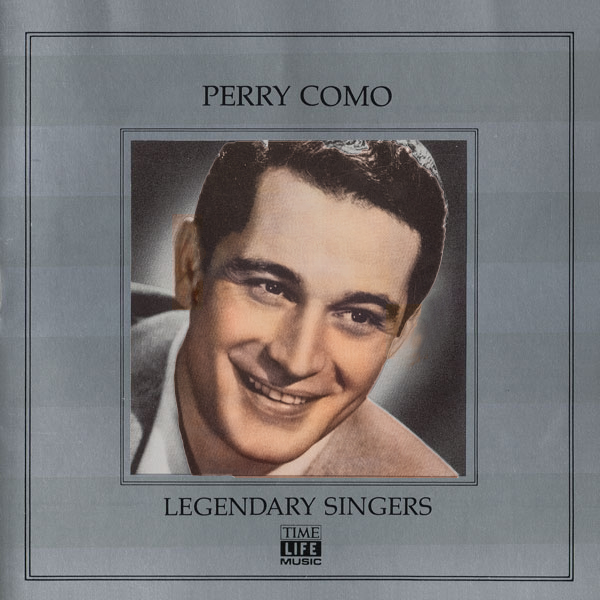
 LEGENDARY SINGERS
Perry Como - Album Notes
Robert Jones
TIME-LIFE RECORDS
SLGD-04
MONAURAL
Manufactured by Capitol
Records
1985 Compilation
LEGENDARY SINGERS
Perry Como - Album Notes
Robert Jones
TIME-LIFE RECORDS
SLGD-04
MONAURAL
Manufactured by Capitol
Records
1985 Compilation
The musicianship took a while, but the voice was always there: a mellow, sweet-timbered baritone with easy high notes, an absolutely even vibrato and plenty of breath to hold it up. As with all star singers, Como's voice is unique and instantly identifiable. His image is one of masculinity tempered by tenderness, Como never pushes for volume, nor does he ever seem to work for effect. He just sings, and the words and phrases fall into place as only a master musician can make them fall. In the early '40s, the years of his first success, Como's tone never dried out, and his top notes never flew sharp or sagged flat. Four decades later they still don't. Perry Como in his early seventies sounds scarily the way he did at 30. How he does it not even Como professes to know. "as for training," he once said, "perish the thought. What is there to train? I've never studied singing. I don't practice. I just open up my mouth at eight o'clock and out it comes ― I hope." In fact, it came out with a success beyond his imaginings. Thirteen gold records decorate his walls (nine singles and four albums that sold more than 500,000 copies each). His 15-minute TV offering, The Perry Como Show, in 1955, first aired in 1948, became the most popular quarter-hour show of all. Then came the hour-long Saturday night Perry Como Show, in 1955, and in turn was topped in 1959 by the Perry Como Kraft Music Hall on NBC, a show that was beamed all over the world. Como has wowed folks in Japan, England, Scotland and on the Continent, among other places. When RCA marked its 100-million-record star's 40th year with the company by throwing a big party in New York, Mayor Ed Koch judged that one day of celebration was obviously inadequate, and proclaimed Perry Como Week in New York City.
Pierino Ronald Como was, in fact, the seventh son of a seventh son ― long thought to be a lucky, even mystical, formula. He showed his initiative early: Not liking the idea of toiling in the Pennsylvania coal pits or as a mill hand like his father ― who at one time supported his family on $37 a week ― Pierino decided to become a barber. At the age of 11, he was apprenticed to a local barber shop, and he spent the next 10 years cutting hair, going to school, and playing guitar and trombone in local groups. He often sang in the shop, imitating such popular singers of the day as Russ Columbo and Bing Crosby. His customers gave him encouragement , so Como finally auditioned for Freddy Carlone, a well-known local bandleader, who offered him a job at $28 a week. Como tried both barbering and singing until 1933 when he married his childhood sweetheart, Roselle Belline, and settled on singing as a career. In 1983, while celebrating 50 years in show business, he and Roselle also celebrated their golden wedding anniversary. In 1936, though, it looked as though life was going to be just a series of one-night gigs with Carlone's band. Then one evening, when Como was singing at a Warren, Ohio, gambling casino, in walked Ted Weems, one of the most popular bandleaders in the nation. Weems won a round at the roulette tables, was in a fine mood and was mightily impressed with the sounds that were coming from handsome young Como. As it happened, he needed a singer for his band. When the casino crowd called on Como for six encores, Weems knew he had found his new vocalist. Como joined Weems, but things didn't go too well at first. Vocally unformed and professionally unskilled, the newcomer irked critical listeners with his amateurish delivery. One important Chicago radio station even threatened to stop broadcasting the Weems band if the young singer did not shape up. Weems sat Como down and made him listen to some records of his work. "I can't understand what I'm saying," Como admitted to Weems who later recalled: "I told him he been endowed with a fine voice and there was no need to embellish it with vocal tricks. Just open up and sing the words from the heart. From then on, his enunciation improved, and so did his professional stature." For a few years Como's career simmered along nicely under Weems' tutelage, his poise and musicianship growing along with a sizeable following of fans. But when World War II came along and Weems's band broke up, Como was prepared to resume his career as a Canonsburg barber. Then he met Tom Rockwell. a powerful agent; Como told him he was tired of doing one-night stand and wanted radio and recording work. It was a shrewd, or at least a lucky, move, for the big-band era was fizzling out and the age of the star male crooners was just beginning. Crosby was already big, a skinny kid named Frank Sinatra was driving the bobbysoxers wild and Dick Haymes was up-and-coming. The possibilities seemed limitless for somebody as romantic looking and smooth sounding as Perry Como. RCA Victor seemed to think so, and they signed Como to a contract in 1943. So did 2oth Century-Fox, hoping Como would become a film star. Como's movie career was pleasant but brief ― he asked for release from his contract in 1947. But his recording career with RCA was another matter. His first 1943 single, Goodbye Sue, was a best-seller. In 1945 Como came up with two blockbusters in a row ― If I Loved You and Till the End of Time ― and suddenly he made history as the first singer to have two simultaneous million-plus sellers. Through the rest of the '40s he assed to his reputation by making new hits from such old songs as Temptation, Prisoner of Love and When You Were Sweet Sixteen. In recognition of his genius for turning revivals into gold, Variety gave him the title "Maker of Songs."
His own family life reflected this public portrait. Life with Roselle continued blissful, spelled by just enough disagreements to keep boredom at bay. They raised three children (two sons and a daughter) in careful privacy, and later rejoiced in eight grandchildren ― whose hair Grandpa delighted in cutting. Como has kept on singing nearly as well as ever, though not nearly so often. He plays a lot of golf and worries about his weight (always between 165 and 175 pounds) and has taken up fishing near his Florida home. He has also made regular appearances on lavish television specials. In 1983 President Reagan sent him agolden anniversary telegram: "The singular qualities of your deep rich voice and nearly effortless styls have made you an outstanding star of radio, recordings and television." But the best summing-up of his career came from Como himself. Recalling his first gig at $28 a week, he had atypcally modest comment: "It was fun. I had a ball. It got me out of the barbershop." Original Album Notes Robert Jones  Produced
for Time-Life Music in cooperation with Capitol Records,
Inc.
Recording
Producer: Michael Brooks.
Remastered
at RCA Studios, New York and half-speed mastered by
Trutone Records, Haworth, New Jersey
Pressings
by Electrosound, Inc., Shelbyville, Indiana.
All
tracks in Monaural
Album
notes by Robert Jones
Original
Compilation 1985.
Produced
for Time-Life Music in cooperation with Capitol Records,
Inc.
Recording
Producer: Michael Brooks.
Remastered
at RCA Studios, New York and half-speed mastered by
Trutone Records, Haworth, New Jersey
Pressings
by Electrosound, Inc., Shelbyville, Indiana.
All
tracks in Monaural
Album
notes by Robert Jones
Original
Compilation 1985.
|
 Few
singers have gone so far with such a gentle disarming voice and
personality as Perry Como. Two generations of television viewers
have been charmed by his pleasantly handsome face and have basked in
the consoling warmth of his lush Mediterranean voice. Wags of the
'50s called him 'the walking Miltown" in tribute to that once-famous
tranquilizer. Not for Como the hard-hitting theatricality of a
Presley or a Tony Bennett, the tough sadness of a Sinatra, the boozy
whimsicality of a Dean Martin. With Como, it has always been calm,
neighbourly manners and an irresistible smoothness that captivated
women as much as it comforted men. Not to speak of his genuinely
beautiful voice and pristine musicianship.
Few
singers have gone so far with such a gentle disarming voice and
personality as Perry Como. Two generations of television viewers
have been charmed by his pleasantly handsome face and have basked in
the consoling warmth of his lush Mediterranean voice. Wags of the
'50s called him 'the walking Miltown" in tribute to that once-famous
tranquilizer. Not for Como the hard-hitting theatricality of a
Presley or a Tony Bennett, the tough sadness of a Sinatra, the boozy
whimsicality of a Dean Martin. With Como, it has always been calm,
neighbourly manners and an irresistible smoothness that captivated
women as much as it comforted men. Not to speak of his genuinely
beautiful voice and pristine musicianship.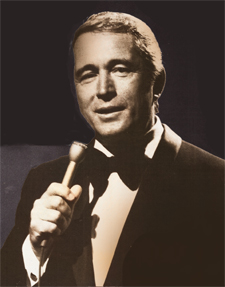 Throughout
his long and steady parade of success, Como has retained his legendary
cool. That laid-back air, though, is not the whole picture. Beneath the
familiar nonchalance lie strong ambition and an ability to work
relentlessly toward a given goal. For this side of his character, Como
has always given credit to his parents, immigrants who came from the
Abruzzi region of Italy in the first decade of the 20th Century with
their six children ― and immediately set about producing seven more. The
future singer was the first of the Como brood born in America, on May
18, 1912, in Canonsburg, Pennsylvania.
Throughout
his long and steady parade of success, Como has retained his legendary
cool. That laid-back air, though, is not the whole picture. Beneath the
familiar nonchalance lie strong ambition and an ability to work
relentlessly toward a given goal. For this side of his character, Como
has always given credit to his parents, immigrants who came from the
Abruzzi region of Italy in the first decade of the 20th Century with
their six children ― and immediately set about producing seven more. The
future singer was the first of the Como brood born in America, on May
18, 1912, in Canonsburg, Pennsylvania. 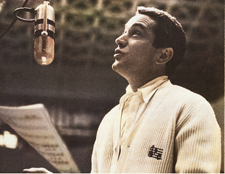 In
the early '50s, the public mood once again began to change. Romantic
crooners slipped in popularity and more strenuous singers like
Johnnie Ray and Frankie Laine became fashionable. Even Sinatra
suffered a career crisis. But not Como. Perry continued much as
before, finding the new medium of television ideally suited to his
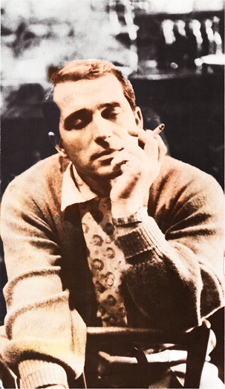
intimate, low-key style. Perched on a stool, lounging on a step,
strolling casually around a set in his trademark sweater, Como
became virtually a member of every American household owning a small
screen.
In
the early '50s, the public mood once again began to change. Romantic
crooners slipped in popularity and more strenuous singers like
Johnnie Ray and Frankie Laine became fashionable. Even Sinatra
suffered a career crisis. But not Como. Perry continued much as
before, finding the new medium of television ideally suited to his
intimate, low-key style. Perched on a stool, lounging on a step,
strolling casually around a set in his trademark sweater, Como
became virtually a member of every American household owning a small
screen.


