 RCA VICTOR 45 EPA
728
MONAURAL
ASSEMBLED IN 1956
RCA VICTOR 45 EPA
728
MONAURAL
ASSEMBLED IN 1956
 Perry Como
and The
Fontane Sisters
Mitchell Ayres' Orchestra and Chorus
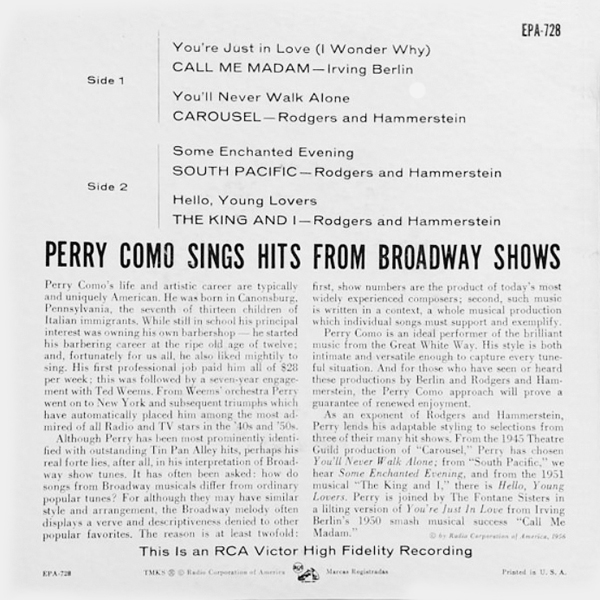
Perry Como’s life and
artistic career are typically and uniquely American. He was born in
Canonsburg, Pennsylvania, the seventh of thirteen children of Italian
immigrants. While still in school his principal interest was owning
his own barbershop — he started his barbering career at the ripe old
age of twelve; and, fortunately for us all, he also liked mightily to
sing. His first professional job paid him all of $28 per week; this
was followed by a seven-year engagement with Ted Weems. From Weems’
orchestra Perry went on to New York and subsequent triumphs which have
automatically placed him among the most popular and most admired of
all Radio and TV stars in the ‘40s and ‘50s.
Although Perry has been
prominently identified with outstanding Tin Pan Alley hits, perhaps
his real forte lies, after all, in his interpretation of Broadway show
tunes. It has often been asked: how do songs from Broadway musicals
differ from ordinary popular tunes? For although they may have similar
style and arrangement, the Broadway melody often displays a verve and
descriptiveness denied to other popular favorites. The reason is at
least twofold: first, show numbers are the product of today’s most
widely experienced composers; second, such music is written in a
context, a whole musical production which individual songs must
support and exemplify.
Perry Como is an ideal
performer of the brilliant music from the Great White Way. His style
is both intimate and versatile enough to capture every tuneful
situation. And for those who have seen or heard these productions, the
Perry Como approach will prove a guarantee of renewed enjoyment.
In the year 1950 appeared two
smash musical successes: Frank Loesser’s "Guys and Dolls,"
based on the novel characterizations of Damon Runyon, and Irving
Berlin’s "Call Me Madam." From the first, Perry here sings A Bushel and a Peck in a sparkling duet with Betty Hutton,
while from the second he interprets Marrying for Love, You’re
Just in Love, and It’s a Lovely Day Today — the last
two with The Fontane Sisters.
As an exponent of Rodgers and
Hammerstein, Perry lends his adaptable styling to selections from
three of their many hit shows. From the 1945 Theatre Guild
Production of "Carousel," Perry has chosen You’ll Never Walk
Alone; from "South Pacific," we
hear Some Enchanted Evening,
and from the 1951 musical "The King and I," there is Hello,
Young Lovers. Perry is joined by the
Fontane Sisters in a lilting version of You're Just In Love
from Irving Berlin's 1950 smash
musical success "Call Me Madam."
Copyright 1956, Radio
Corporation of America
This is an RCA Victor High Fidelity Recording
Perry Como
and The
Fontane Sisters
Mitchell Ayres' Orchestra and Chorus
Perry Como’s life and
artistic career are typically and uniquely American. He was born in
Canonsburg, Pennsylvania, the seventh of thirteen children of Italian
immigrants. While still in school his principal interest was owning
his own barbershop — he started his barbering career at the ripe old
age of twelve; and, fortunately for us all, he also liked mightily to
sing. His first professional job paid him all of $28 per week; this
was followed by a seven-year engagement with Ted Weems. From Weems’
orchestra Perry went on to New York and subsequent triumphs which have
automatically placed him among the most popular and most admired of
all Radio and TV stars in the ‘40s and ‘50s.
Although Perry has been
prominently identified with outstanding Tin Pan Alley hits, perhaps
his real forte lies, after all, in his interpretation of Broadway show
tunes. It has often been asked: how do songs from Broadway musicals
differ from ordinary popular tunes? For although they may have similar
style and arrangement, the Broadway melody often displays a verve and
descriptiveness denied to other popular favorites. The reason is at
least twofold: first, show numbers are the product of today’s most
widely experienced composers; second, such music is written in a
context, a whole musical production which individual songs must
support and exemplify.
Perry Como is an ideal
performer of the brilliant music from the Great White Way. His style
is both intimate and versatile enough to capture every tuneful
situation. And for those who have seen or heard these productions, the
Perry Como approach will prove a guarantee of renewed enjoyment.
In the year 1950 appeared two
smash musical successes: Frank Loesser’s "Guys and Dolls,"
based on the novel characterizations of Damon Runyon, and Irving
Berlin’s "Call Me Madam." From the first, Perry here sings A Bushel and a Peck in a sparkling duet with Betty Hutton,
while from the second he interprets Marrying for Love, You’re
Just in Love, and It’s a Lovely Day Today — the last
two with The Fontane Sisters.
As an exponent of Rodgers and
Hammerstein, Perry lends his adaptable styling to selections from
three of their many hit shows. From the 1945 Theatre Guild
Production of "Carousel," Perry has chosen You’ll Never Walk
Alone; from "South Pacific," we
hear Some Enchanted Evening,
and from the 1951 musical "The King and I," there is Hello,
Young Lovers. Perry is joined by the
Fontane Sisters in a lilting version of You're Just In Love
from Irving Berlin's 1950 smash
musical success "Call Me Madam."
Copyright 1956, Radio
Corporation of America
This is an RCA Victor High Fidelity Recording
|


